What Is the Style of Art Called With Many Dividing Lines and Colors
Westith the name originally being coined past fine art critics as a mode to ridicule the technique, Pointillism adult as role of the Post-Impressionist motion in the late 1880s. This art technique involved painting tiny yet singled-out dots adjacent to one some other in social club to class an image. Many artists began to adopt this technique of painting and subsequently the 1890s, once Pointillism has reached its height, it led the style to the development of the Fauvist fine art motion.
Table of Contents
- 1 What Is Pointillism?
- 2 A History of Pointillism
- 3 Technique and Practice of Pointillism
- three.1 Science of the Eye
- 3.2 Points of Undiluted and Unmixed Color
- 3.three Precise Technique
- 4 Characteristics of Pointillism
- v Understanding the Distinction Between Pointillism and Divisionism
- vi Agreement the Distinction Between Pointillism and Dotted Art
- 7 Famous Pointillism Artists and Their Paintings
- 7.1 Camille Pissarro (1830 – 1903)
- 7.2 Vincent van Gogh (1853 – 1890)
- 7.iii Charles Angrand (1854 – 1926)
- 7.iv Henri-Edmond Cross (1856 – 1910)
- 7.v Maximilien Luce (1858 – 1941)
- 7.six Georges Seurat (1859 – 1891)
- 7.7 Théo van Rysselberghe (1862 – 1926)
- 7.8 Paul Signac (1863 – 1935)
- viii The Legacy of Pointillism
- nine Influence of Pointillism on Contemporary Artists Today
- 9.1 Damien Hirst (Built-in 1965)
- nine.2 Philip Karlberg (Built-in 1973)
- x Farther Reading
- 10.1 Ways of Pointillism: Seurat, Signac, Van Gogh
- x.2 Georges Seurat (Getting to Know the Globe's Greatest Artists)
What Is Pointillism?
The revolutionary painting technique that eventually became known equally Pointillism attempted to utilize the science of optics when creating paintings. This was washed by painting small but separate dots of unmixed colors side past side, which were placed in various patterns in society to grade an image.
The effect that this had was that in placing the dots and so close to i another, they would automatically blur into an epitome by the optics of viewers. This technique resembles the manner computer screens work today, as the pixels on the screen resemble the dots in a Pointillism painting.
Pointillism art reinvented the use of painting with pocket-sized dabs of paint that were made famous by the Impressionist movement, to the signal where artists attempted to produce an entire painting out of these footling dots of pure color. Therefore, it is frequently viewed as part of the Post-Impressionist movement, as information technology rose in popularity between the 1880s and 1890s after the Impressionist period had concluded.
One may wonder why artists went to so much trouble to develop this innovative withal uniquely complex technique. This was simply due to the fact that they wanted to remodel and transform what fine art stood for. In doing so, they were able to present a new definition of what it meant to be an artist at the time.
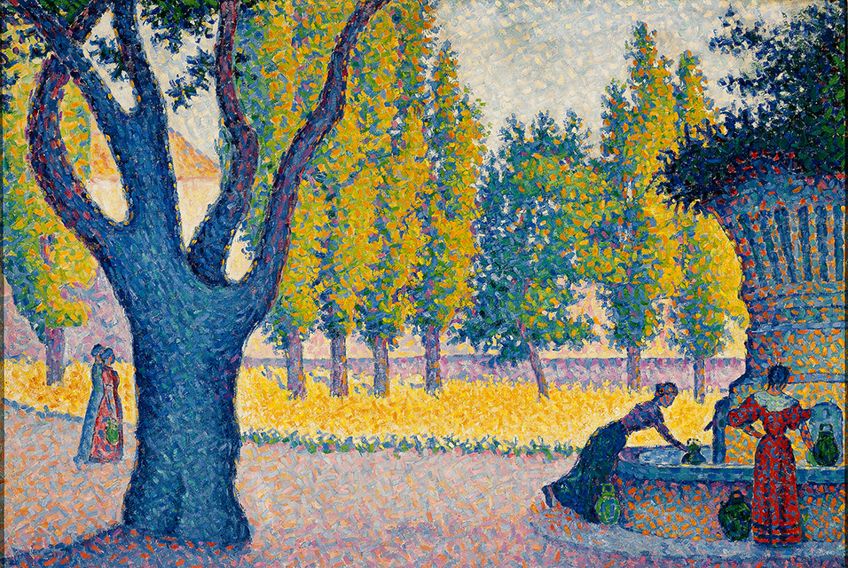 Saint-Tropez. Fontaine des Lices (1895) past Paul Signac;Paul Signac, Public domain, via Wikimedia Eatables
A History of Pointillism
Primarily invented past French artists Georges Seurat and Paul Signac in 1886, Pointillism developed in response to the popular movement of Impressionism that dominated. Pointillism contrasted heavily confronting other fine art techniques that were created during the Impressionist movement, as information technology required a much more than scientific arroyo to be taken past artists. Impressionism was still largely based on the subjective opinions of individual artists at the fourth dimension, which many artists who sought a new art technique did non agree with.
Along with Georges Seurat and Paul Signac, many other notable French, Belgian, and Italian artists existed equally leading members of the Pointillist group. Some of these artists were their swain Frenchmen Maximilien Luce and Henri-Edmond Cantankerous. Other artists briefly experimented with the Pointillist style at i signal in their careers, such as Vincent van Gogh and Pablo Picasso.
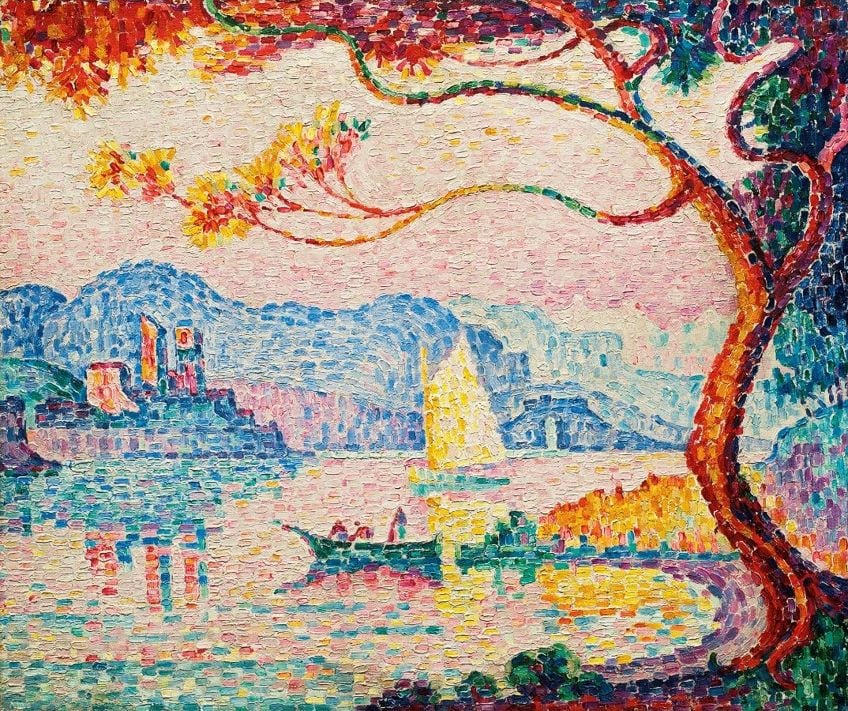 Antibes. Petit Port de Bacon (1917) by Paul Signac; Paul Signac, Public domain, via Wikimedia Commons
The term "Pointillism" was initially made up past art critics as a way to mock this seemingly cool art technique. Nonetheless, as the popularity surrounding the technique grew, Pointillism was adopted as the official name and abandoned its earlier derogatory implication.
Earlier it was known equally Pointillism, this style of painting was referred to equally "Divisionism", which has since gone on to develop into a similar still distinct technique of painting
Pointillism art, which established itself during the Neo-Impressionist menses of art, attempted to mimic the style that lite works, every bit pocket-size individual dots were packed tightly next to each other to permit optical mixing to take place. When viewed from afar, the result of this technique meant that the viewer'south mind and center would exist able to mistiness the dots together in society to create a detailed image. This optical mixing also displayed images that had a more complete and vivid range of hues than what the atypical dots were able to provide alone.
While Impressionist artists like Vincent van Gogh and Claude Monet often fabricated use of tiny dabs and strokes of paint as role of their technique, the Pointillist manner extended this idea farther. Every bit an fine art technique, Pointillism was relatively easy to understand as it solely comprised of applying pocket-sized dots of color onto a sheet. Additionally, pioneers Seurat and Signac made the fashion wait very elementary through the exquisite paintings that they produced when in fact the technique was quite circuitous to become correct.
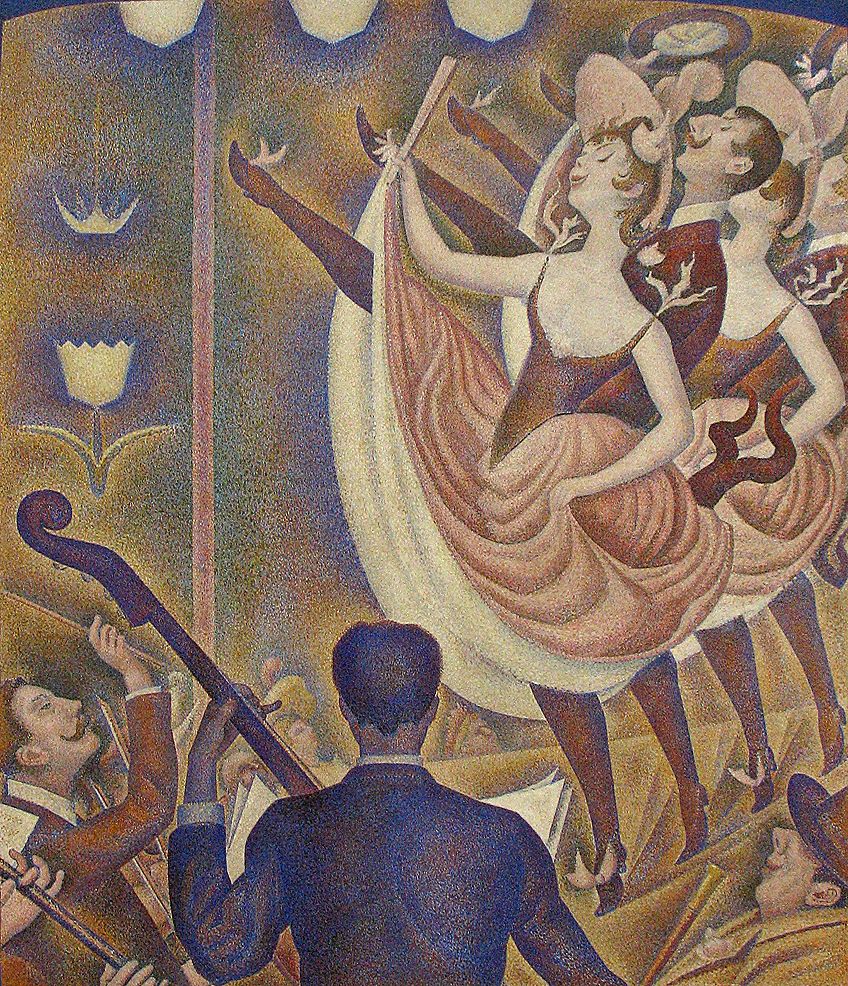 Le Chahut ('The Can Can', 1890) by Georges Seurat;Georges Seurat, Public domain, via Wikimedia Commons
Due to Pointillism attempting to imitate how low-cal and color were perceived, it existed as a very scientific and technical style. This meant that artists practicing this technique had to be well-informed nigh where to place their dots in relation to their other spots of color in order for their images to correctly form at a later stage.
As more artists began adopting this famous dot painting technique, which was also referred to equally "dotted art" in a more colloquial context, the Pointillist technique became one of the most forwards-thinking art styles of that era. Every bit information technology presented an entirely new understanding of the subject of color studies, Pointillism had a massive influence on various art movements that developed. These spanned from the cease of the xixthursday century throughout the avant-garde stages of the 20thcentury.
While the Pointillist arroyo was primarily seen to belong exclusively to the Mail-Impressionist movement, it also had an impact on the subsequent development of both Cubism and Pop Art. When considering the contemporary art trends today, many artists still make utilise of this remarkable technique in their art.
Elements of Pointillism are too seen in the pixels from digital screens and in reckoner fine art today. However, while the logic may appear to be similar, the style and context of pixel fine art and Pointillism are vastly different.
Technique and Do of Pointillism
Inspired by the Impressionist paintings of the day, Seurat and Signac attempted to recreate paintings that depicted light in its changing qualities through a new technique, in order to produce paintings with overwhelming brightness. Seurat began to place small dabs and points of pure colour onto a canvas in certain patterns that would transform into beautiful images when viewed together, and thus Pointillism art was built-in.
The technique of Pointillism was hard for artists to get the hang of at first, as it took advantage of the way in which our eyes function with our brains. When looking at a Pointillist painting, our eyes automatically blend the numerous different colored dots to form a solid paradigm. Due to the scientific influence behind this technique, very few artists exist who still pigment this way today.
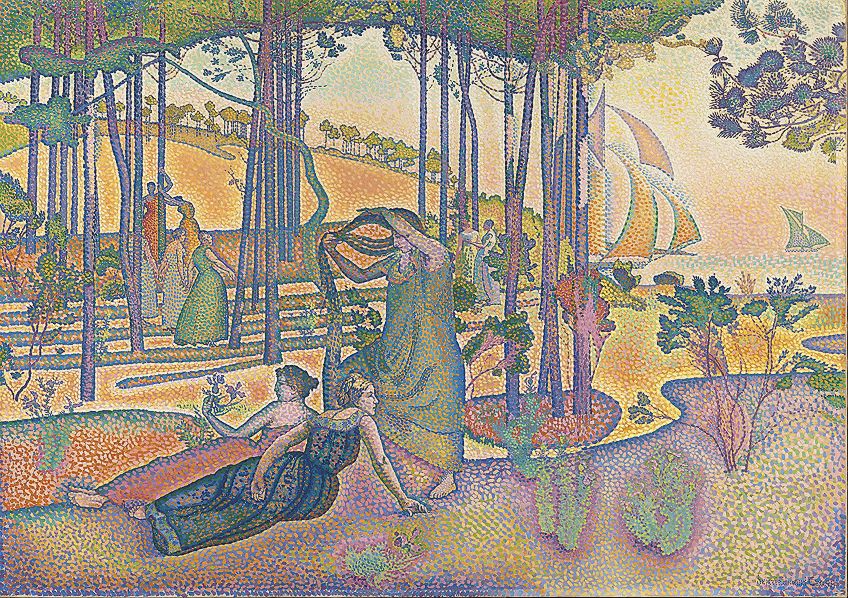 L'air du soir ('The Evening Air', c. 1893) by Henri-Edmond Cantankerous; Henri-Edmond Cross, Public domain, via Wikimedia Eatables
As it was loosely related to Divisionism, many wondered: what is Pointillism? Essentially, while Divisionism was interested in color theory, Pointillism placed its focus on the specific manner of brushwork that was used when applying paint. Thus, Pointillism existed equally the more than technical variation of this specific style. Pointillism existed as a stark dissimilarity to the traditional methods of mixing pigments on a palette, as the technique relied on the ability of the eyes and minds of viewers to mix the color spots into various tones.
This famous dot painting technique is similar to the four-colour CMYK press process that is used past color printers today, where cyan (C), magenta (M), yellowish (Y), and blackness (1000) are combined to produce different colors. Whilst this process can exist compared to Pointillism due to some loose similarities, Pointillism placed greater focus on a variety of features that made up the technique. These features have been explained below.
Science of the Eye
Pointillism was 1 of the most scientific approaches that developed in relation to the production of fine art. An important influence on the theory behind Pointillism was French chemist Michel Eugène Chevreul, who wrote a book while researching ways to improve the strength of colors for a Parisian tapestry company. Chevreul concluded that the visual impact of the tapestries relied on optics and the juxtaposition of complementary colors, with Pointillism drawing heaving on these results in the paintings that were produced.
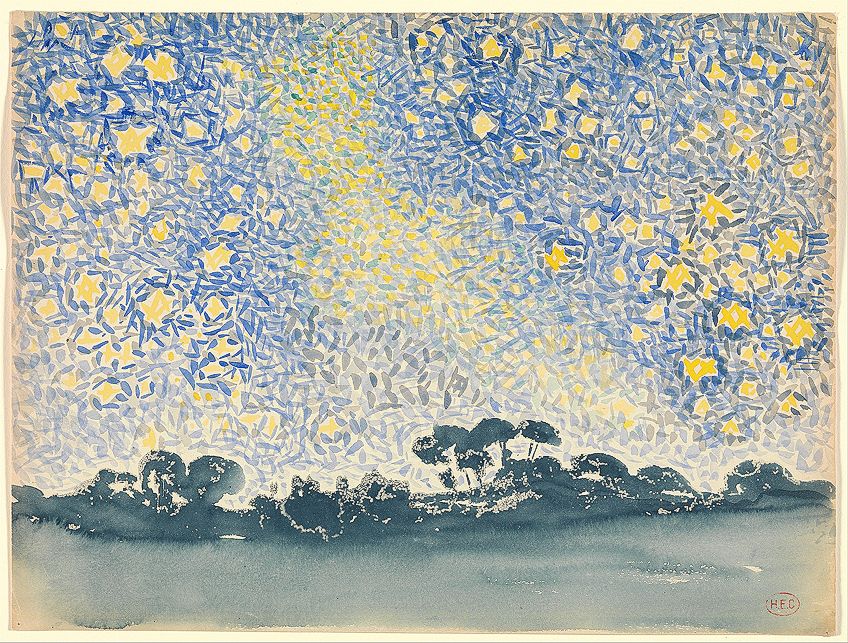 Landscape with Stars (c. 1905-1908) past Henri-Edmond Cross;Henri-Edmond Cross, CC0, via Wikimedia Commons
Points of Undiluted and Unmixed Color
When using the Pointillist technique, artists made apply of dots of pure and unblended colors when creating their paintings. These dots were and then advisedly placed in areas where the artist knew they would be correctly blended by the viewer's eye and accept a more striking effect. Due to this, artists never mixed colors equally once they were blended, they somehow lost their luminosity. Additionally, the smaller these dots were, the sharper the lines were and the clearer the painting became.
Precise Technique
This Neo-Impressionist technique was an incredibly meticulous ane, as it focused on the idea of optical illusion. Pointillism artists rejected fluid and spontaneous strokes in favor of a more authentic and methodical fashion of painting. Every Pointillism painting was advisedly planned out earlier artists began applying paint so that they knew more or less what the effect of their artwork would look like. Due to the technicality of this technique, most Pointillism art was washed in oil paint, as information technology was preferred for its thickness and tendency to not run.
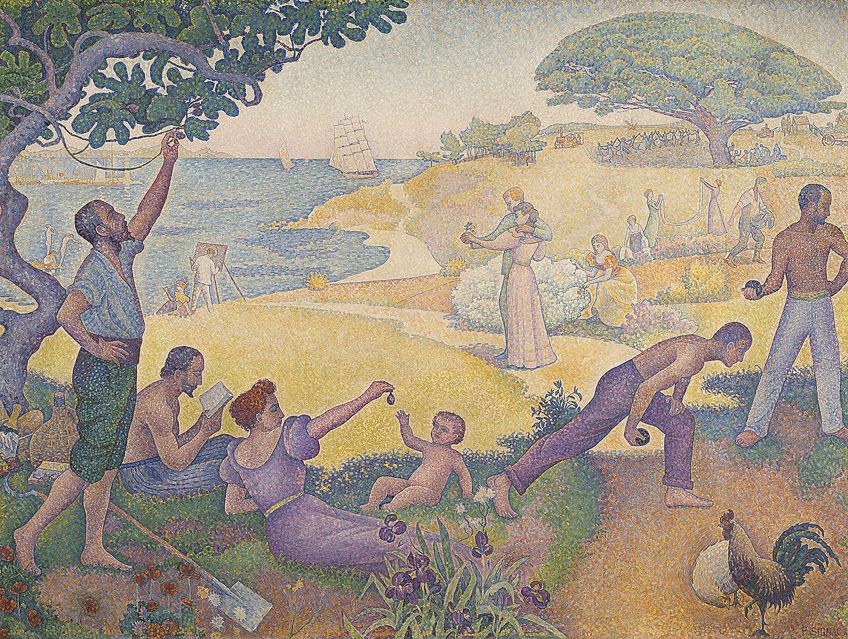 Au temps d'harmonie: l'âge d'or n'est pas dans le passé, il est dans fifty'avenir ('In the Time of Harmony: The Golden Age is Not in the Past, it is notwithstanding to come', 1896) by Paul Signac;Paul Signac, Public domain, via Wikimedia Commons
Characteristics of Pointillism
Pointillism was an Impressionist-inspired technique that looked to reinvent the fashion landscapes, portraits, and seascapes were painted within the Neo-Impressionist movement. Its name was influenced past art critic Félix Fénéon, who first used the expression "painting by dots" when attempting to describe this curious manner of painting.
While Seurat preferred the proper name "Divisionism" or "Chromoluminarism" for the technique he invented, "Pointillism" was eventually derived from Fénéon's expression and stuck.
Rather than mixing color on a palette before using them, Pointillism was characterized by its application of pure colors directly placed on a canvas. This was because raw pigments were able to hold their genuine brightness when left unblended, which made the technique of Pointillism so groundbreaking. Additionally, round or sometimes square brushes were used when painting, which allowed the blending of the colors to happen on the canvas through the viewer's eye.
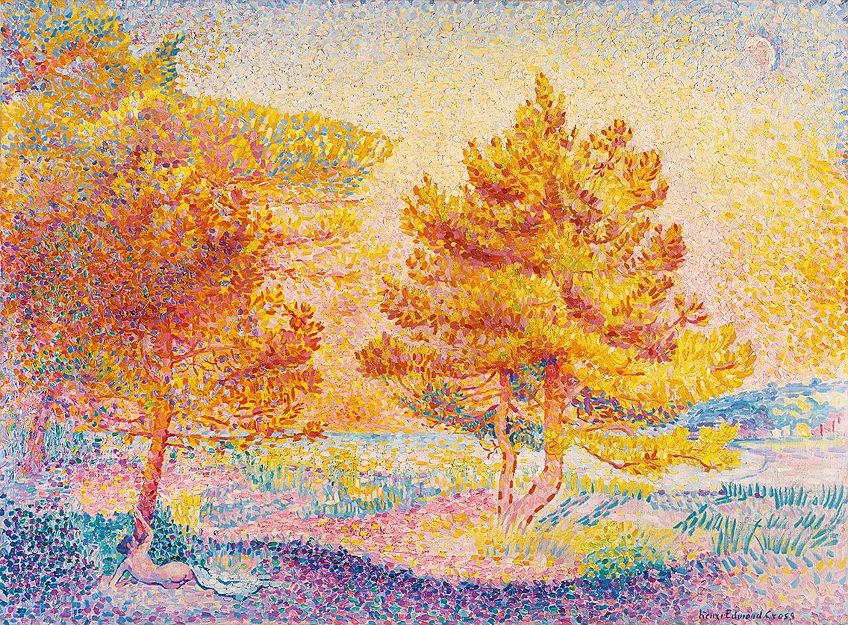 Les pins ('The Pines', 1897-1899) by Henri-Edmond Cross;Henri-Edmond Cross, Public domain, via Wikimedia Commons
Pointillism was also characterized by a saturation of the tones used, as colors were typically vivid and bright. When creating these intense colors, Pointillism artists used dissimilar varieties of the same shade without blending the pigments. In doing so, they helped canvases to look softer and less visually hostile, in addition to creating these vibrant hues. This excessive use of color in Pointillism art was said to have paved the way for the development of the Fauvist and Surrealist movements, as they both made apply of striking colors.
Lastly, 1 of the master characteristics to ascertain Pointillism was that the dots were only able to be differentiated from ane another when viewed from a specific distance. Mostly, the spotted touches of the paintbrush required viewers to automatically take a few steps back in lodge to run across the emergence of the painting as a whole.
Thus, Pointillism paintings were characterized by the distance they required from viewers when looking at the completed artwork, every bit the further away the viewer was, the more "whole" the painting appeared.
Understanding the Stardom Betwixt Pointillism and Divisionism
At certain times throughout art history, Pointillism has been incorrectly associated with Divisionism. This was because the technique of Divisionism, sometimes referred to as Chromoluminarism, emerged at the same fourth dimension as Pointillism and was also thought to be part of the Post-Impressionism motility. Divisionists made apply of a like approach when forming images through the patterns created, only the last result of their practice differed vastly from Pointillism.
Divisionism surfaced due to the scientific theories and rules of color that had been established and was influenced past the theory of contrasting colors, which was developed by French art critic Charles Blanc. While Divisionism was engaged with colors and how they could be divided, Pointillism focused on the possibilities of creating patterns out of dots that formed into coherent images when viewed from distant. This difference was seen in Pointillism art, as no consideration was given to the separation of colors in one case the slice had formed.
Perhaps the biggest difference between these two styles was seen in the final product, as Divisionists made use of bigger cube-like brushstrokes, while Pointillism artists characterized their composition with small-scale, multicolored dots.
Ultimately, the confusion between these two fine art techniques was thought to be based on the fact that the same group of artists who developed Pointillism helped facilitate the emergence of Divisionism. Seurat, Signac, and even van Gogh were known to practice with both techniques.
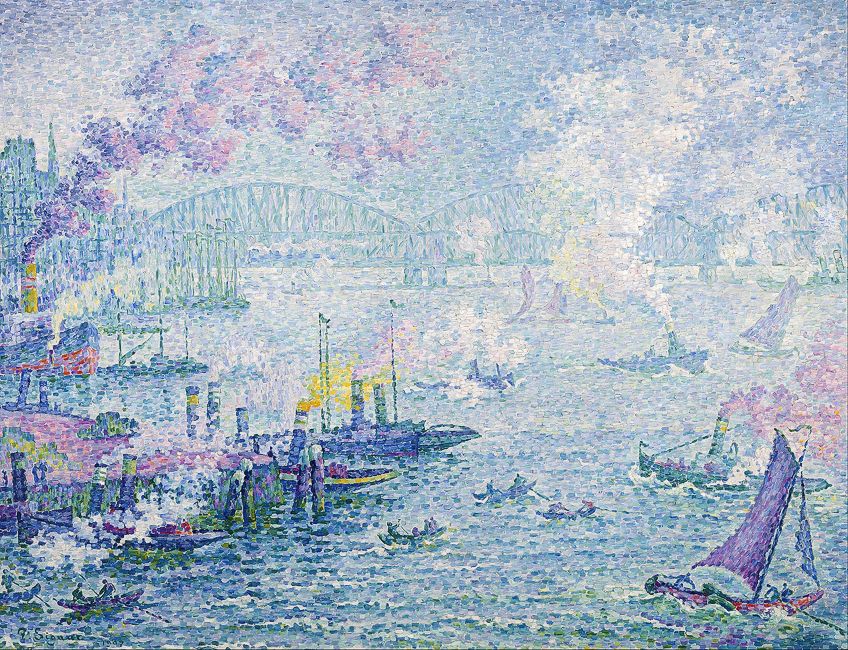 The Port of Rotterdam (1907) by Paul Signac;Paul Signac, Public domain, via Wikimedia Commons
Agreement the Distinction Betwixt Pointillism and Dotted Art
While Pointillism has been referred to as "famous dot painting" in the past, the technique is substantially the same matter equally Dotted Art. The only difference that exists betwixt these 2 terms is that "Pointillism" is used by fine art historians and collectors to refer to artworks that take used this technique, while "Dotted Art" is used in a more colloquial setting amongst the general public.
A well-known example of Dotted Art is Aboriginal art, which made apply of dots and stipples within the famous stone paintings. However, Dotted Art is used to refer to the work of amateur artists today, as the term places less pressure level and expectation on the works that are produced as opposed to labeling them as Pointillism art.
Thus, apart from these contextualizing differences, nothing else stands out that differentiates Pointillism from Dotted Art.
Famous Pointillism Artists and Their Paintings
Many of the artworks that were created using the Pointillist technique exist as some of the most significant paintings to engagement. In this adjacent department, we volition be taking a await at and exploring some of the most well-known Pointillism artists and their infamous Pointillism art.
Camille Pissarro (1830 – 1903)
Practicing within both the Impressionist and Neo-Impressionist move, Danish-French artist Camille Pissarro perfected his technique of portraying the ordinary life within his paintings. Pissarro sought to explore new themes and methods that would allow him to break out of the contemporary painting manner of his time, choosing to return to depictions of ordinary individuals in very realistic settings.
It was at this betoken in his creative style when Pissarro met Georges Seurat and Paul Signac, who had already begun to use the Pointillist technique. Pissarro readily embraced and implemented Pointillism in his works and was one of the artists whose works greatly stood out within the Pointillist group. A well-known Pointillism painting of his is Gelée Blanche, Jeune Paysanne Faisant du Feu, which he painted betwixt 1887 and 1888.
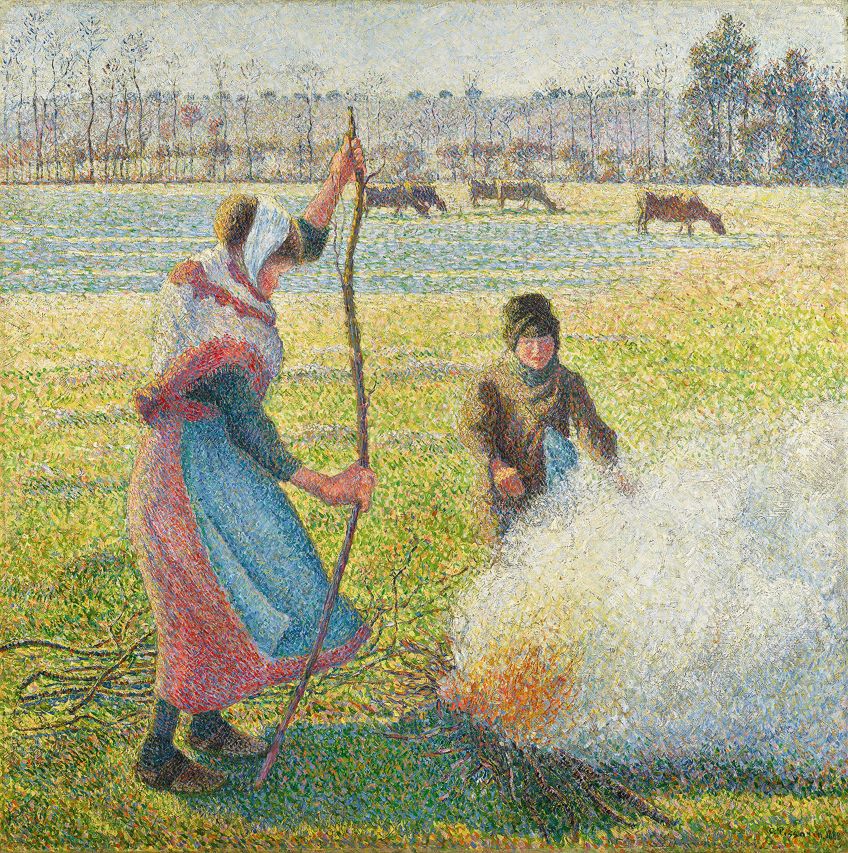 Gelée blanche, jeune paysanne faisant du feu ('Hoarfrost, Peasant Girl Making a Burn', 1887-1888) past Camille Pissarro;Camille Pissarro, Public domain, via Wikimedia Commons
Existing on quite a grand scale, this painting demonstrates how Pissarro was able to dispense the complex subject of light. His bright depiction of the intricacies between low-cal and atmosphere is seen by his portrayal of both heat and cold, as the depression sun is shown to exist casting shadows on the meadows and the remaining dark frost. Additionally, some mist can be seen rising in the background, which is contrasted against the weak withal shimmering light that is depicted.
Within this painting, Pissarro was able to create an extraordinary and uniquely subtle illustration of fume, fire, and common cold air, that was not able to exist matched in other Pointillist fine art produced. In addition to the brilliance Pissarro displayed when considering the furnishings of lite, his empathetic arroyo to the human condition within his artworks set his paintings apart from others.
Vincent van Gogh (1853 – 1890)
A Dutch painter who was known to briefly experiment with Pointillism was Vincent van Gogh. After visiting Georges Seurat'southward studio, van Gogh exclaimed that he had come up into contact with a "revelation of color", which led to him beginning to pigment using the Pointillist technique. However, information technology was generally agreed past art historians that van Gogh was too much of an unsettled spirit to go on within a style equally technical equally Pointillism, as demonstrated by him moving on from the technique after a brusque period of time.
A well-known painting of van Gogh's that clearly demonstrates the use of Pointillism is his 1887 Cocky Portrait. Inside this painting, van Gogh responded to Seurat's iconic painting, A Sunday on La Grande Jatte (1884), and fabricated utilise of thick brushwork which would keep to get a trademark of his style. However, the deviation in van Gogh'southward painting was that he attached passionate emotional linguistic communication to his colour palette called, while Seurat and other'south artists based their technique on the cool detachment related to science.
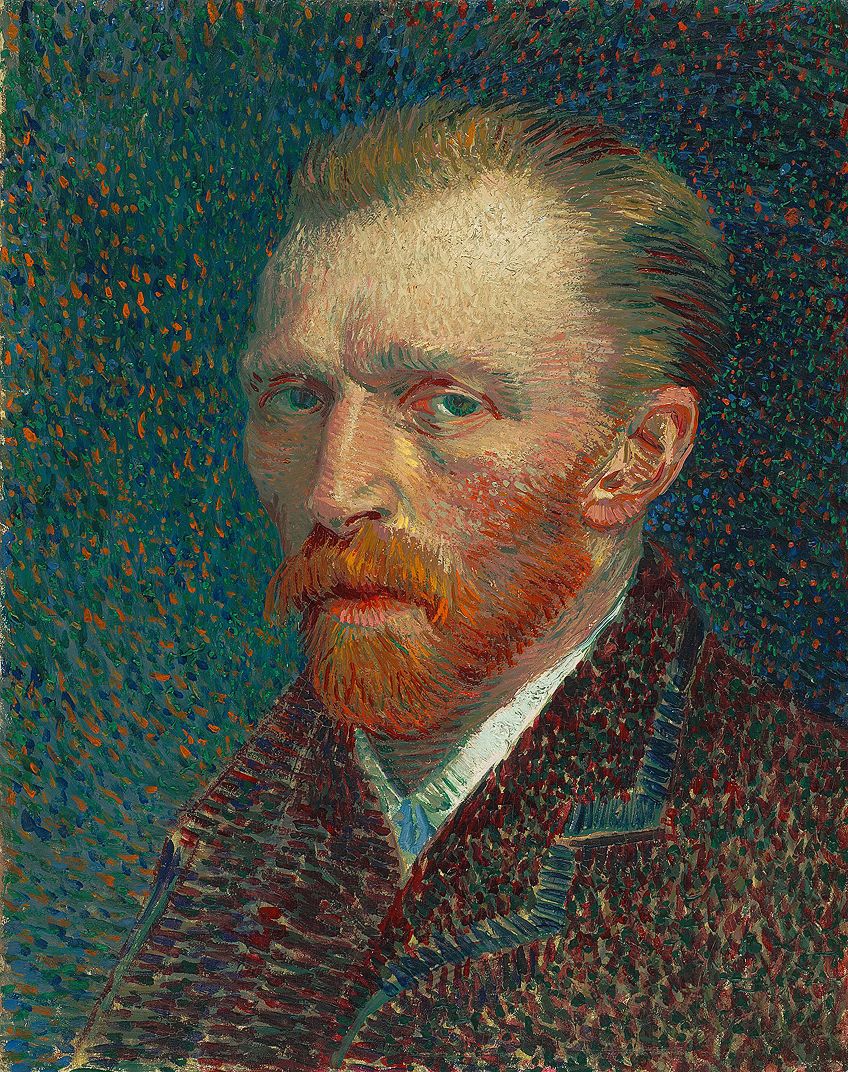 Self-Portrait (1887) by Vincent van Gogh;Vincent van Gogh, Public domain, via Wikimedia Commons
The surface of Self Portrait dazzles with specks of color including greens, blues, oranges, and reds. The dissimilarity between the absurd and warm tones creates a sparkling upshot, every bit it appears that the background behind van Gogh is full of motility. While viewers cannot help but become caught upwards in the rhythm created by the precipitous and asunder dabs of paint, van Gogh's deep green eyes seem to convey a deep intensity that acts as some other focal point in the piece of work.
Van Gogh demonstrated a bully skill for expressing the fluidity of light, which was taught to him by fellow artist Camille Pissarro.
Van Gogh became a temporary tenant in Pissarro'south habitation and during this time spent together, Pissarro taught him the different means of finding and expressing lite and color, with this skill being identified in his Self Portrait.
Charles Angrand (1854 – 1926)
Another French artist who gained widespread acknowledgment for his paintings was Charles Angrand. Influenced by members of the Pointillist group, such as Camille Pissarro, Georges Seurat, and Paul Signac, Angrand began to implement Pointillist techniques inside his ain paintings, despite his implementations different from the work of other Pointillism artists.
One of Angrand'south notable Pointillism paintings is The Harvesters, painted in 1892. Inside most of Angrand's artworks, you can meet that his choice of colors is more than subdued than the bright and contrasting colors that were typically used in the works of Seurat and Signac. Angrand was said to consciously avoid the vehement coloration observed in many other Pointillism paintings, equally he felt that his muted theme immune him to ameliorate capture and execute depictions of lite in his artworks.
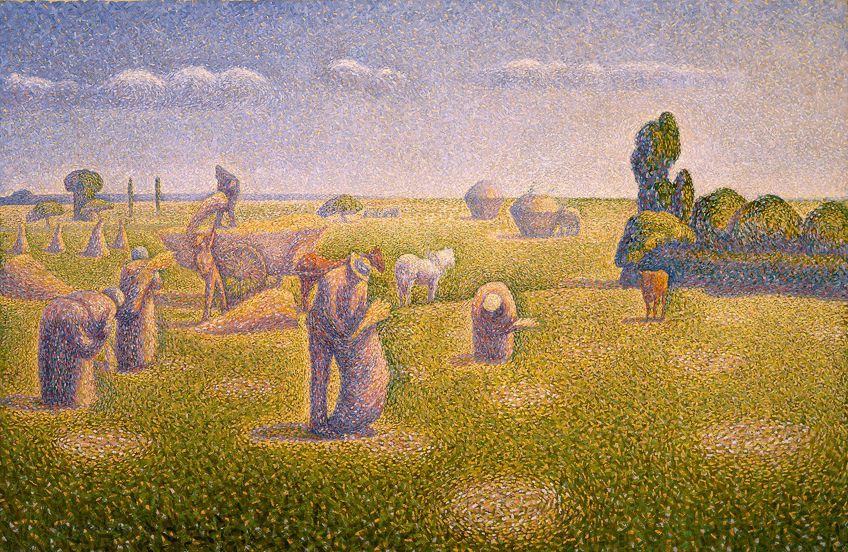 The Harvesters (1892) past Charles Angrand;Charles Angrand, Public domain, via Wikimedia Commons
Still, within The Harvesters, Angrand copied the style and color palette of Seurat and Signac, with this painting existing as one of his more colorful artworks. This is demonstrated by the warm tones used to draw the workers in the field, in add-on to the seemingly heated glow of light that appears to exist washing over them.
The contrast created between the warm tones of the figures and the cool tones found inside the groundwork demonstrates how perceptive Angrand was when it came to portraying the transient chemical element of lite.
Henri-Edmond Cross (1856 – 1910)
French painter Henri-Edmond Cross was a famed creative person within the Neo-Impressionist motion and was among the most pregnant artists who made use of the Pointillist technique. While experimenting with Pointillism, Cantankerous exerted an instrumental influence on the fine art world, which helped pave the style for the evolution of Fauvism. In 1884, Cross co-founded the "Société des Artistes Indépendants" which led to his meeting of creatives who shared the same values, including Pointillism artists Georges Seurat and Charles Angrand.
Despite forming a close relationship with these artists, Cross simply began to pigment using the Pointillist technique in 1891. His beginning Pointillist painting, created in that same year, was a portrait of his future wife and was titled Madame Hector France. Inside this large, full-length portrait of Irma Clare, who was married to the author Hector France at the time, a careful balance between lite and shade is depicted.
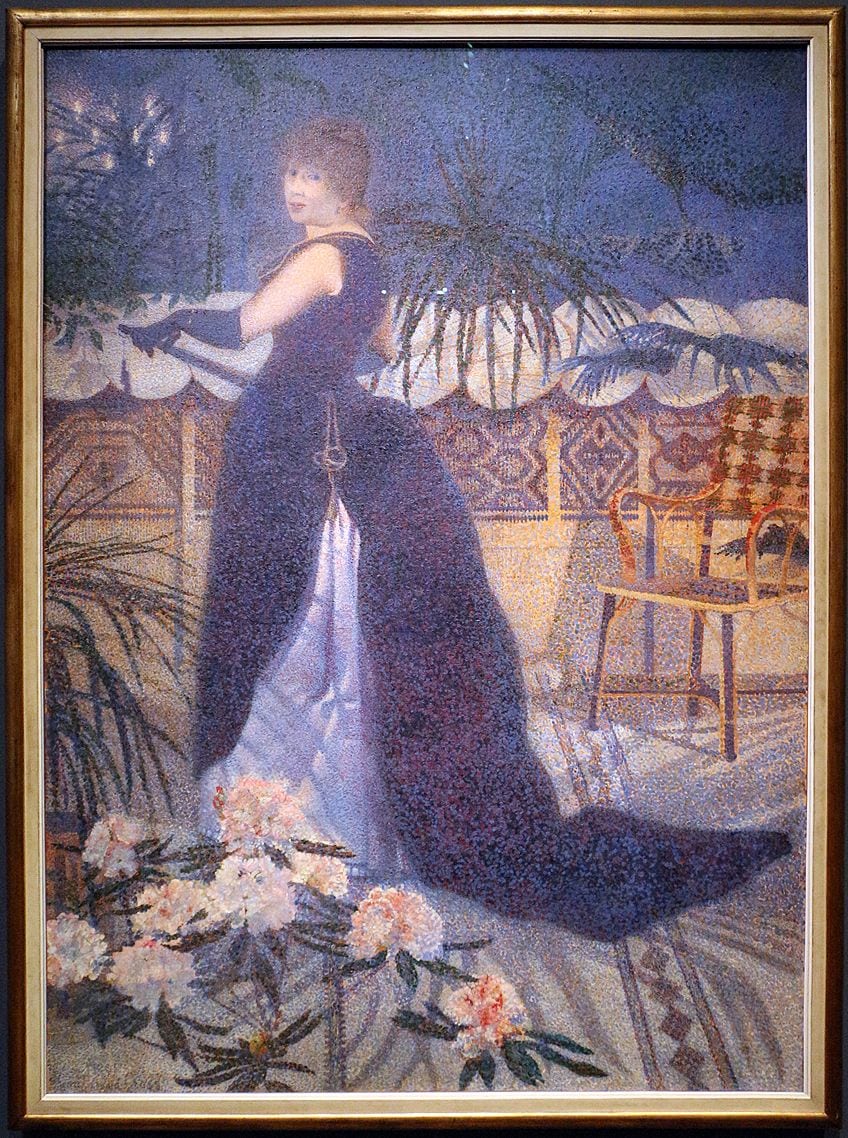 Madame Hector French republic (1891) by Henri-Edmond Cross;Musée d'Orsay, CC By iii.0, via Wikimedia Commons
The light, which is suggestive of a summer night, is represented past the twinkling lamps in the background, too equally the white rhododendron that is seen in the foreground. These areas of illumination are further contrasted with the dark colors that are used to draw Madame France's dress, including the slight shadow that falls across her confront. Within this painting, Cross was likewise able to create the illusion of depth and space, past portraying the chair at an angle, and the inclusion of the geometric shapes that embrace the flooring.
Despite employing the techniques of Pointillism, it has been said that Cross' painting was more Divisionist in fashion. This was because his portrait seemed to have a grainy yet atmospheric glow to it, which perchance demonstrates a greater focus on the division of colors as opposed to the patterns of the dots.
Maximilien Luce (1858 – 1941)
Some other prominent French artist who was significant inside the Pointillism era was Maximilien Luce, who somewhen returned to Impressionism once Pointillism began to decline. Within most of his Pointillist artworks, Luce depicted scenes of ordinary people at piece of work. Ane of his about notable pieces, which shows a man getting fix for work in the morning time, was Morning, Interior, painted in 1890. The man in this painting was said to be Luce's shut friend and young man Neo-Impressionist creative person, Gustave Perrot.
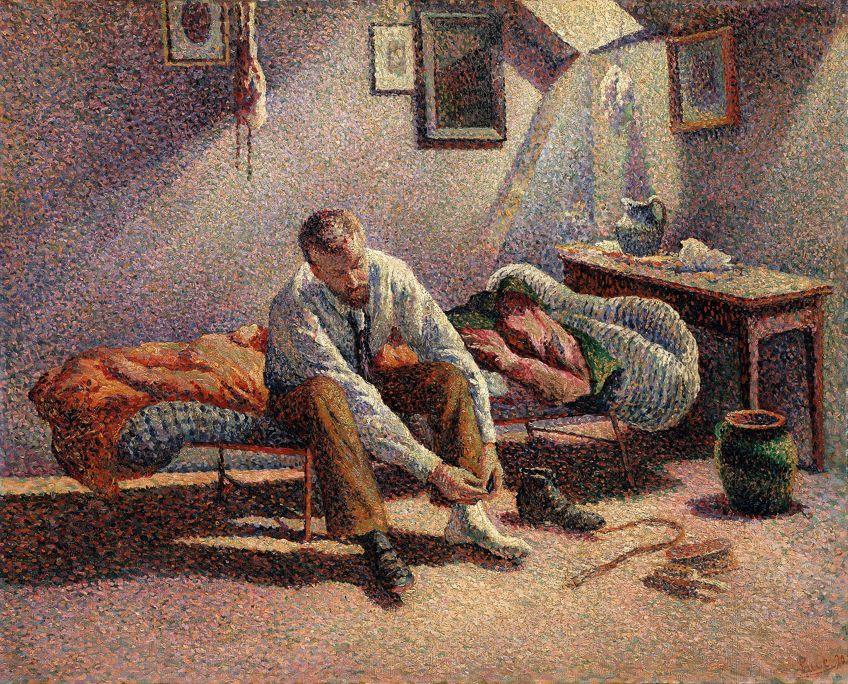 Forenoon, Interior (1890) by Maximilien Luce;Maximilien Luce, Public domain, via Wikimedia Commons
Within this painting, a swain is shown to be sitting on a flimsy bed while putting his left boot on. The room is scantily furnished, but what grabs our attention is the delineation of the early morning sunlight that is streaming into the room through the windows. In an attempt to capture this lite, Luce rendered the room in points of yellow, orange, and carmine, which creates a vibrant portrayal of the warmth brought forth by the light. Spots of light bluish and violet can also be seen, which complement the warmer tones and further emphasize the light present.
The contrasting colors used by Luce assist to modulate the differing fall of light throughout the room, as demonstrated by the colors used to prove the vase, bedclothes, and vase. Through this gentle depiction of calorie-free, an incredibly intimate scene is shown of an individual presumed to exist the artist Perrot going nearly his morning time activities of getting dressed in his simple living quarters. The stippled technique that Luce fabricated use of inside this painting was uniquely Pointillist, showing his influence over the style.
Georges Seurat (1859 – 1891)
The offset pioneer of Pointillism and the almost important artists within this technique was French painter Georges Seurat, whose short career fabricated a great impact on the artistic community. Typically known equally Seurat Pointillism, this technique helped Seurat found the Neo-Impressionist movement within which Pointillism brutal and practiced. Seurat was incredibly mathematical in his arroyo to Pointillism painting, with his precision and logical abstractions existence viewed in the majority of the artworks he created.
Maybe the virtually well-known masterpiece of Pointillism, in add-on to being i of the well-nigh significant paintings created within art history, is Seurat'south A Lord's day Afternoon on the Island of La Grande Jatte , painted betwixt 1884 and 1886. This painting portrays members of dissimilar social classes relaxing on an island in the Seine River known equally La Grande Jatte and taking part in various park activities.
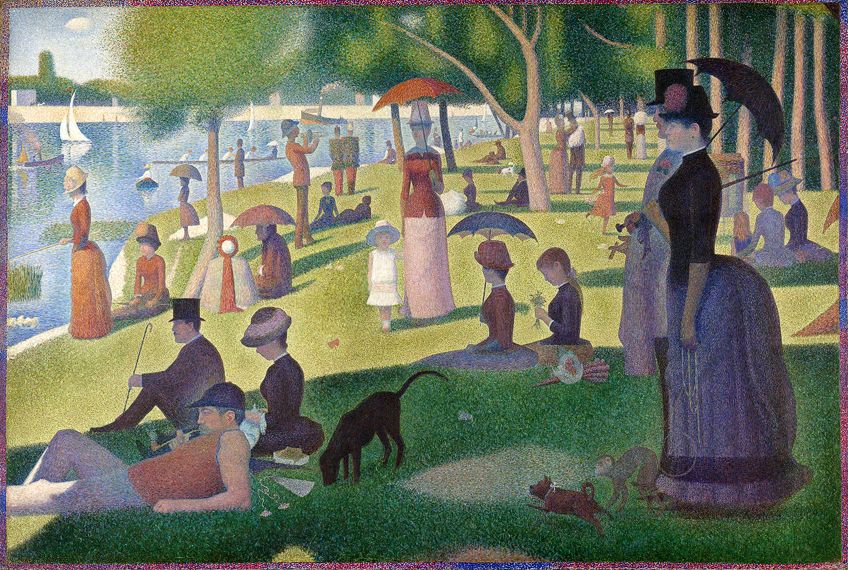 Un dimanche après-midi à l'Île de la Grande Jatte ('A Sunday Afternoon on the Island of La Grande Jatte', 1884-1886) by Georges Seurat; Georges Seurat, Public domain, via Wikimedia Commons
Seurat worked in a highly systematic mode and completed this entire painting through the use of tiny dots that contrasted in color, which allowed the viewer's optics to blend the colors optically. Due to the sheer size of the artwork and the technicality of this style, it took Seurat two years to fully consummate this painting, equally he spent the majority of that fourth dimension in the park sketching virtually 60 studies in preparation.
A masterful manipulation with light and shadow can be seen, as the shimmering river contrasts heavily against the shade in the bottom left corner, as well as the shadows created by all of the figures who are standing upright. Additionally, the inclusion of umbrellas adds to this thought of shade, as the figures holding the umbrellas are bathed in both shade and calorie-free.
Despite Seurat'southward artwork taking a more scientific and intuitive arroyo to fine art cosmos, not all is every bit information technology seems. Upon closer inspection, certain anomalies leap out.
For example, the lady depicted in darker tones in the bottom left corner appears to be belongings a monkey on a ternion, which is running adjacent to a dog. Some other difference from the style and so carefully created past Seurat within this work is seen in the little girl placed in the middle of the composition, as she is the merely figure to exist portrayed without a shadow.
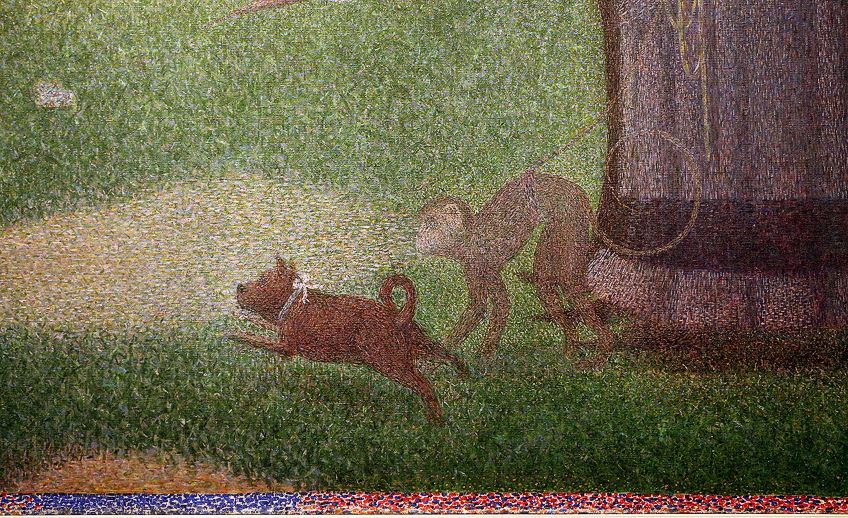 A item of Seurat's A Sun Afternoon on the Island of La Grande Jatte, indicating the monkey on a ternion equally well every bit the orange, ruby-red, and blue border;Georges Seurat, CC BY 3.0, via Wikimedia Commons
In 1889, Seurat fabricated 1 final modify to A Sunday Afternoon on the Isle of La Grande Jatte. He diffuse the canvas so that he could add a painted border made up of orange, red, and bluish dots. This was done to provide a visual passageway between the inner of the painting and its white frame. Unfortunately, Seurat's life ended tragically at the historic period of 31 due to diphtheria. Even so, the legacy of Seurat Pointillism lived on through other notable artists who experimented with his technique.
Théo van Rysselberghe (1862 – 1926)
Belgian artist Théo van Rysselberghe was another prominent artist who made use of Pointillism and played a crucial function in the European art scene at the beginning of the 20thursday century. Van Rysselberghe typically experimented with portraiture during his Pointillism period, as he often painted portraits of his wife and daughter. However, some of his more iconic Pointillist pieces depicted landscapes and seascapes.
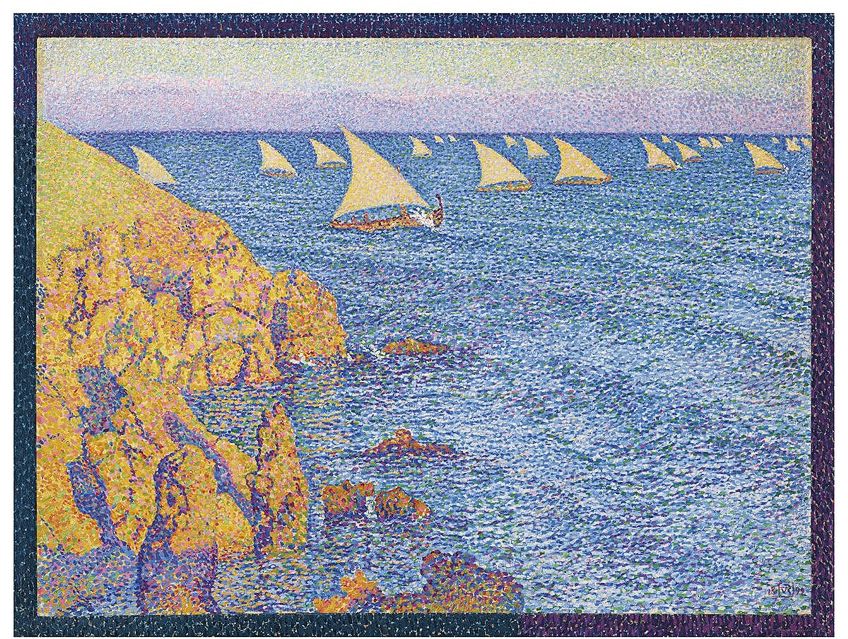 Barques de pêche-Méditerranée ('Angling Boats in the Mediterranian', 1892) by Théo van Rysselberghe;Théo van Rysselberghe, Public domain, via Wikimedia Commons
One of van Rysselberghe'due south virtually iconic Pointillist artworks, as well as one of the most beautiful Pointillist paintings to exist, is his 1892 painting Fishing Boats in the Mediterranian. This painting depicts the turquoise blue water of the Mediterranean sea reflecting the sun's rays as the waves roll. A large fleet of fishing boats sails past an outcrop of orangish-glowing rocks, basking in the gilt glow of the Mediterranean calorie-free.
This painting includes some of the purest forms of divisionist applications, which can be seen in the regulation of shapes within the painting. Perhaps inspired by Impressionist Naturalism, this pointillist painting offers an abstract representation of an open seascape, complete with boats, ocean water, and sunlight. Within this painting, you tin see the delineation of the natural world through ordered geometric shapes of different colors.
The complementary sets of colors of both orange and blueish and yellow and purple allow for the distension of the overall abstruse composition of the painting. At the aforementioned time, however, the vantage indicate from which the viewer is placed hints at a precariousness of staining over a cliff'southward edge, relating to the physicality of our ain reality.This painting also provides a great sense of temporality in the way the unending nature of the ocean water contrasts to the fragility of the passing ships, completely helpless to the effects of the body of water, like to how humankind is subject to the trials and tribulations of life.
Towards the end of the 1890s, van Rysselberghe abased the utilize of small-scale dots and went on to utilize broader castor strokes, which concluded his Pointillism period.
Paul Signac (1863 – 1935)
The other founder of Pointillism, besides as the 2d most of import creative person within this mode, was French painter Paul Signac. Along with Georges Seurat, Signac studied and developed the technique of Pointillism aslope him, as he was a student of Seurat's at the fourth dimension. Later Seurat'south untimely expiry, Signac continued to piece of work within Pointillism throughout the entirety of his career and left an enormous legacy of artworks that fabricated use of the technique.
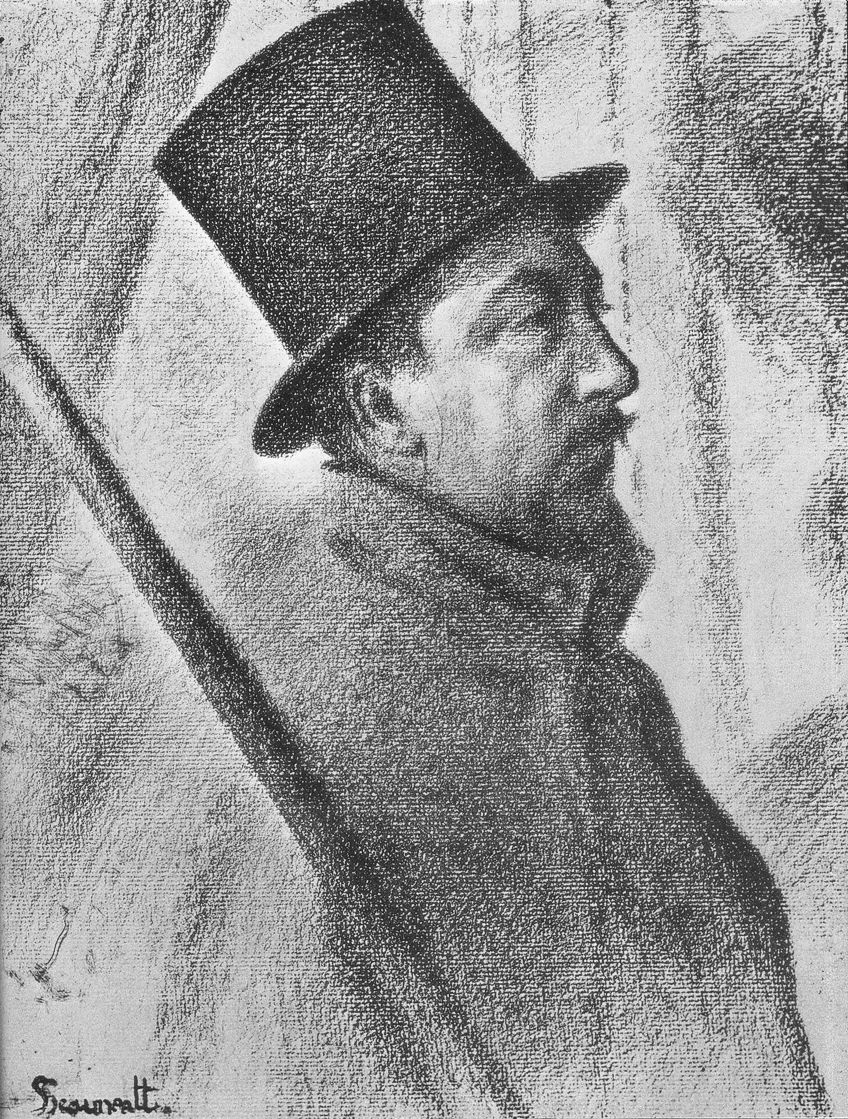 A portrait of Paul Signac (1890) by Georges Seurat;Georges Seurat, Public domain, via Wikimedia Commons
A very well-known work of Signac's, which he painted in 1890, was titled Opus 217. Confronting the Enamel of a Groundwork Rhythmic with Beats and Angles, Tones, and Tints, Portrait of Grand. Félix Fénéon. Within this painting, Signac honored his friend, influential art critic, collector, curator, and dealer Félix Fénéon, in a portrait that remains Signac'due south well-nigh memorable and outstanding artwork.
This portrait illustrates Signac'southward preference for using vibrant and hitting tones, as the combination of colors seems overwhelming at get-go. The color cycle depicted in the background demonstrates Signac's impressive employ of Pointillism, equally viewers have to first optically blend the colors before they are able to make sense of the shapes that form.
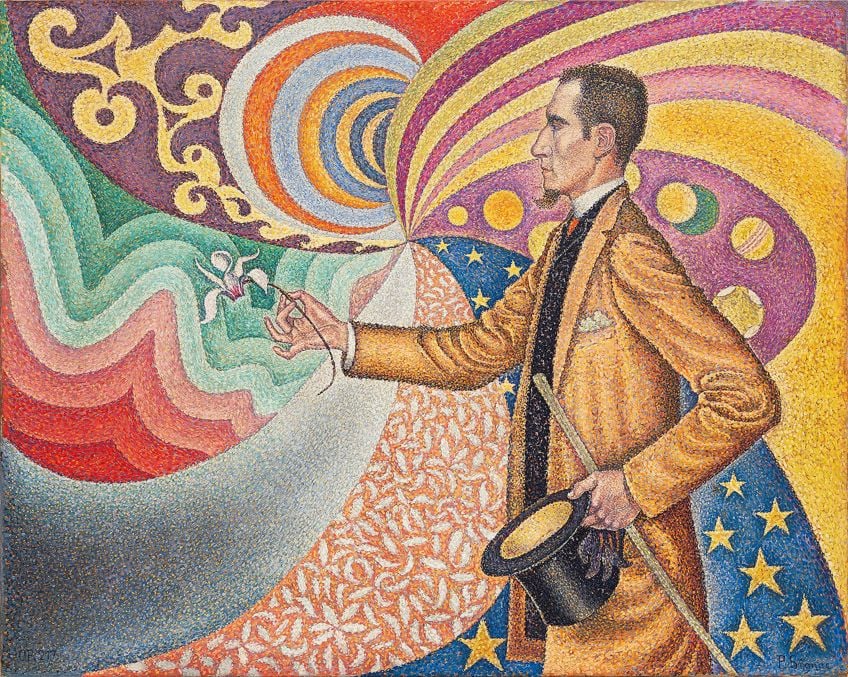 Opus 217. Sur l'émail d'un fond rythmique de mesures et d'angles, de tons et de teintes, Portrait de M. Félix Fénéon(' Opus 217. Against the Enamel of a Background Rhythmic with Beats and Angles, Tones, and Tints, Portrait of Grand. Félix Fénéon', 1890) by Paul Signac;Paul Signac, Public domain, via Wikimedia Commons
While both Fénéon and the white bloom he holds remain motionless confronting the symphony of colors, the championship suggests movement and music through the word "Opus." Additionally, move is implied through the Pointillist technique within this artwork, as the dots of vibrant color seem to vibrate against one another. Fénéon's profile adds to the motion in this painting, as his nose, elbow, and cane pass up in a zigzag type of pattern that is reminiscent of motion.
Within this artwork, Signac artfully demonstrated his manipulation of Pointillism through the vivid dots and angles he made use of. Both elements added to the vibrancy that is felt when looking at this painting, equally it seems to come alive with excited and blithe movement when closely studied.
The Legacy of Pointillism
By the 1890s, Pointillism art had reached its peak, as many artists of the time had adopted the technique in the artworks that were produced. Pointillism had a swell influence on the Post-Impressionist move, which had spilled into the beginning of the 20th century. After this, the style slowly faded out, every bit most artists started to experiment with other forms of artistic creation.
Despite some artists solely practicing inside this technique, while others merely briefly touched on it, there is no denying the not bad influence that Pointillism had on art.
While Pointillism is generally considered to take had the about influence in the technical area of art, its experimentation with color theory and understanding of optical realism opened many doors for future art movements. An important movement that developed in the wake of Pointillism was Fauvism, which was inspired by the vivid utilise of color used by Pointillism artists. Henri Matisse's Luxe, Calme et Volupté (1904) is often said to be an important transitional piece of work between the two styles.
Every bit a painting technique, Pointillism was challenging to master and due to this, not many artists are able to pigment this fashion today. Yet, despite the heyday of Pointillism art beingness over, many of its concepts and ideas are all the same being used by artists in a more contemporary context, who are creating artworks in a diversity of dissimilar mediums. Some of these mediums seen in Modern Art today, that were clearly influenced past Pointillism, include way and tattoos.
Influence of Pointillism on Contemporary Artists Today
Within the modern era, many artists are loosely experimenting with the themes and ideas that were prominent in the Pointillism style. The primary concept of dots has been restructured to fit into a contemporary setting, with many artists making use of dots in diverse shapes and forms for a range of different purposes. Some artists have even created artworks based entirely on dots, demonstrating that Pointillism art remains always-nowadays fifty-fifty in the 21st century.
Damien Hirst (Born 1965)
One of the get-go contemporary artists that come to mind when discussing modern art is British creative person Damien Hirst. While we cannot allocate Hirst as a Pointillist creative person, he did experiment with the technique in a series of dotted paintings that seemed to pay homage to the original style.
His 1986 painting, titled Spotted Painting, was one of Hirst'south first experimental paintings that included dots. When viewing the work, numerous multicolored dots are visible, which seem to have been haphazardly placed all over the canvas. This assumption is justified, as the further one moves away when viewing the piece of work – in an attempt to allow the optical illusion to brand sense – no figures seem to appear from the dots. No matter the distance that is created between the painting and the viewer, the dots are clearly visible from all angles.
In a way, this artwork can exist classified every bit a course of dotted fine art, every bit that is exactly what it is. Hirst'southward Spotted Painting, forth with the other artworks in this series, remains true to what they are, which are essentially a collection of colorful dots.
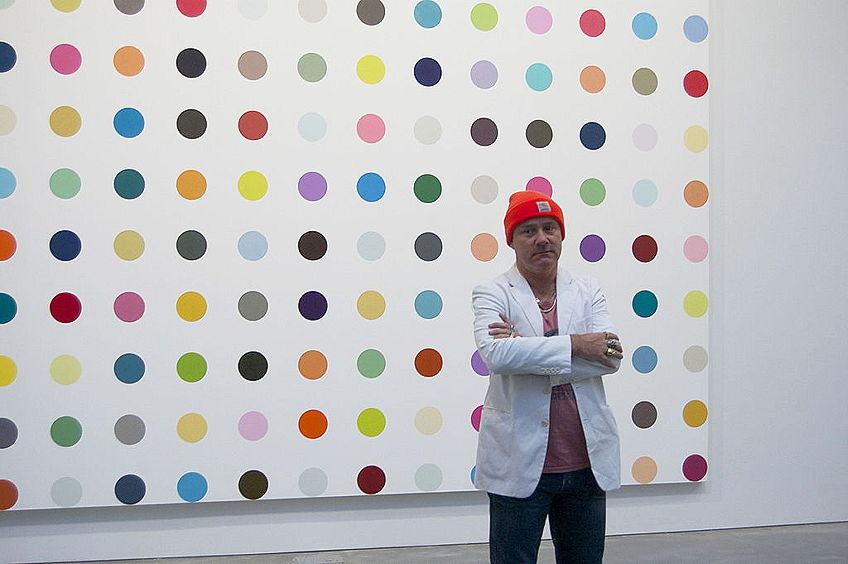 Damien Hirst at the exhibition Damien Hirst: The Consummate Spot Paintings, 1986-2011, Gagosian Gallery, NYC;Andrew Russeth from New York, New York, CC BY-SA 2.0, via Wikimedia Commons
Philip Karlberg (Built-in 1973)
Another modern artist that has been known to incorporate dots and Pointillism theories into his works is Swedish photographer Philip Karlberg. While existence inspired by dots, Karlberg's artistic expression and subsequent creations differ vastly from the original thought of Pointillism, but its influence can clearly be seen in his works.
Undertaking an immense project in 2012, which he labeled his Pivot Art Portraits serial, Karlberg created portraits of iconic figures using over 1200 wooden sticks meticulously arranged on wooden boards to resemble specific celebrities. Some of the celebrities he captured included Johnny Depp, Jackie O, Lady Gaga, and Karl Lagerfeld. In each portrait, Karlberg made each celebrity wearable a designer pair of sunglasses.
Within these heart-catching pieces, Karlberg was inspired by the optical illusion in Pointillism to create these works, whereby the eyes of viewers were also required to arrange the sticks into the faces of these well-known celebrities. The shadow created past each stick, which he stuck into the board at different lengths, helped to further construct the faces of each celebrity, demonstrating Karlberg's use of strategic lighting.
Although it was said to be complicated when it kickoff appeared on the fine art scene, Pointillism'south revolutionary technique led well-nigh artists at the time to experiment with it. The paintings that emerged from this period of art take gone on to become some of the most iconic artworks of all time, as no motility as mathematically technical as Pointillism has developed since. The influence of Pointillism art was too felt far and wide, with this technique existence attributed to the development of other pregnant art movements within art history.
Take a await at our Pointillism fine art webstory here!
Farther Reading
If you have enjoyed reading almost this fascinating and innovative fine art technique, we encourage you to further explore the development of Pointillism forth with its iconic artists. Beneath, we accept listed a book proffer for you to wait at. Additionally, if your children are also interested in finding out near this mode, we have listed an historic period-advisable book that details the technique and its artists in a straightforward fashion.
Means of Pointillism: Seurat, Signac, Van Gogh
Existing as an first-class overview of the history of Pointillism fine art, this book contains the works of bottom-known artists who were besides pivotal in the development of the technique. Numerous photos are included along with the in-depth data, which makes this volume a wealth of information regarding Pointillism and its iconic artists.
- Brings together more than one hundred paintings and drawings
- Takes readers through the motion, from Seurat to Matisse
- Guides readers through this love co-operative of impressionism
View on Amazon
Georges Seurat (Getting to Know the Globe'due south Greatest Artists)
This book, which forms office of the World'south Greatest Artists series, combines a playful mix of colorful historical reproductions, photos, and charming cartoon illustrations. These all bring to life the artworks of Georges Seurat, while adding an element of fun to learning nearly the style of Pointillism. The touching anecdotes, while amusing to wait at, provide children with important factual information almost Pointillism. This book is targeted at children between the ages of viii and nine.
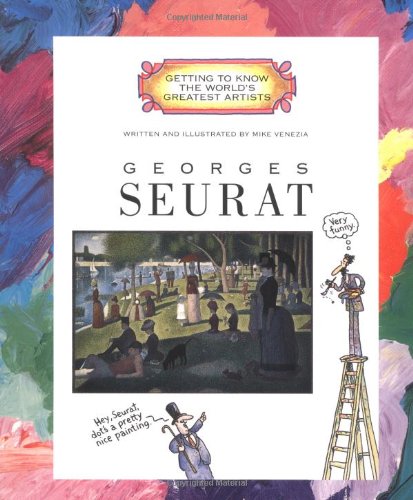
- The life and career of the nineteenth-century artist Georges Seurat
- A delightful mix of historical reproductions, photos, and illustrations
- Combines poignant anecdotes with important factual information
View on Amazon
martinezprobjecre.blogspot.com
Source: https://artincontext.org/pointillism/
0 Response to "What Is the Style of Art Called With Many Dividing Lines and Colors"
Post a Comment